
Front Tooth Implant with Immediate Loading: A Case Restored in One Day
When a front tooth fractures
A root fracture in a central incisor is one of the most difficult moments a patient can face. The tooth cannot be saved, the area is visible in every smile, and the first question our patients ask is almost always the same: “Will I be left without a tooth?”
In selected cases, the answer is no.
With the immediate loading technique, the implant can be placed and receive a temporary tooth on the same day, so that the patient is never left without a tooth in the front of the mouth.
This article presents such a case from our practice: restoration of an upper central incisor, with immediate implant placement into the extraction socket and immediate loading with a temporary crown.
The case was completed with a definitive zirconia crown, fabricated after osseointegration of the implant.
The case
Our patient presented at the practice with a root fracture of an upper central incisor. The tooth had been roughly bonded with composite resin to the adjacent tooth. On examination it was judged non-restorable and had to be extracted.
The challenge in a case like this is twofold:
- The tooth sits in the aesthetic zone, where the result is judged not only by the tooth itself, but also by the appearance of the gum tissue around it.
- The patient did not want to be left with a gap in her front teeth at any stage of treatment.
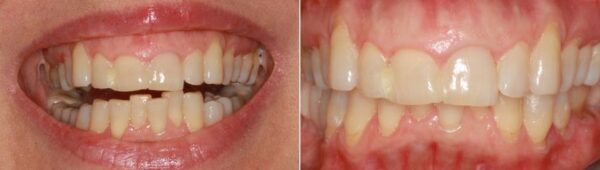
Pre-operative planning with CBCT
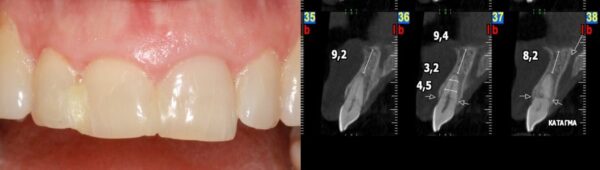
Before any decision, a three-dimensional radiographic examination (CBCT) of the area was performed. This examination is decisive, because it allows us to assess with precision the quantity and quality of the bone, the position in which the implant can be placed, and whether the conditions for immediate placement and loading exist.
The absence of inflammation and the presence of an intact buccal bone plate created favourable conditions for immediate implant placement.
What “immediate loading” means for a front tooth
Immediate loading is the technique in which the implant is placed and, at the same appointment, a temporary tooth is fabricated and fitted onto it.
For a front tooth, this technique offers two significant advantages:
- The patient is never left without a tooth.
- The temporary crown shapes the gum tissue from the very first moment, guiding the tissues so that the final tooth emerges naturally from them.
Immediate loading, however, is not applied to everyone. The essential prerequisite is that the implant achieves sufficient primary stability at placement.
If this stability is not achieved, the correct decision is to follow the conventional protocol with a healing period.
This assessment is made by the clinician at the moment of surgery.
The treatment, step by step
1. Extraction and immediate implant placement
The fractured incisor was extracted with particular care, so that the tissues around the socket would be preserved as far as possible.
The implant was then placed directly into the extraction socket — that is, in the same position and at the same appointment, without an intervening period of socket healing.
The gap between the implant and the post-extraction socket was filled with a graft.
The implant achieved the necessary primary stability, which allowed us to proceed with immediate loading.
2. Same-day temporary crown
At the end of surgery an acrylic temporary crown was fabricated and fitted onto the implant. The patient left the practice with a tooth in place.
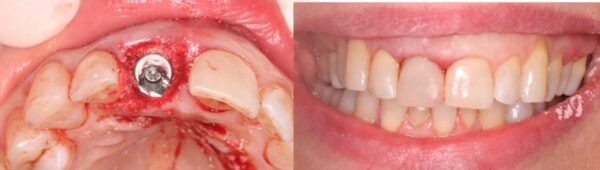
The temporary crown is fitted out of occlusion — that is, it does not come into contact with the lower teeth either when biting or during lateral jaw movements.
We also recommend a soft diet, and avoiding biting with the front tooth during the healing period.
Beyond the obvious aesthetic benefit, the temporary crown has a critical biological role: it shapes the contour of the gum tissue so that it acquires the correct form around the future tooth. In the photograph that follows you can see the temporary crown and the tissue architecture it achieved during its time in the mouth.
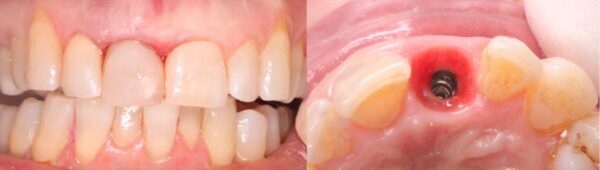
3. Definitive zirconia crown
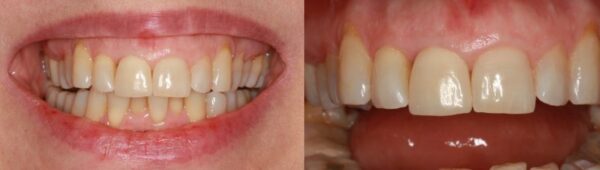
Once healing and osseointegration were complete, the definitive zirconia crown was fabricated.
The great challenge with a single front tooth is that it has to “fit in” alongside the natural teeth without standing out.
For this reason we gave the zirconia the characteristics of a natural tooth, so that the implant would integrate harmoniously into the smile.
Why technique matters in the anterior region
Restoring an implant in a front tooth is among the most demanding procedures in implant dentistry. It is not enough for the tooth to be functional — it must also be invisible as a restoration.
Two factors determine the outcome:
- The quantity and quality of the bone in the area, which is assessed by CBCT before any decision is made.
- The prosthetic techniques used to shape the gum tissue, chief among them the temporary crown that guides the tissues.
Immediate placement and loading, when conditions allow, combine functional and aesthetic benefit and reduce the overall treatment time.
Frequently asked questions
Can I have an implant placed on the same day my front tooth is extracted?
In many cases yes, using the immediate placement technique. The implant is positioned in the extraction socket at the same appointment. Suitability is judged on the bone of the area, which is assessed by three-dimensional radiography (CBCT) before surgery.
Will I be without a front tooth during treatment?
No, when immediate loading is applied. At the same appointment a temporary crown is fabricated and fitted onto the implant, so that you are not left with a gap in the visible area.
Why is a temporary tooth needed before the final one?
Beyond the aesthetic benefit, the temporary crown shapes the form of the gum tissue around the implant. This is decisive in allowing the final tooth to emerge naturally from the gum.
Is immediate loading suitable for every patient?
No. The essential prerequisite is that the implant achieves sufficient primary stability at placement. If this is not achieved, the conventional protocol with a healing period is followed. The decision is made by the clinician at the time of surgery.
What material is the final tooth made from?
In this case the definitive crown was made of zirconia, characterised to reproduce the features of a natural tooth so that it integrates aesthetically with the adjacent teeth.
80 Kifisias Avenue, Athens ·
Request an appointment
