
When Veneers Are Not the Right Treatment: Seven Clinical Situations to Resolve First
Veneers are among the most frequently requested aesthetic restorations.
They are an excellent way of improving the appearance of the teeth and the smile, and because they require minimal preparation of the teeth they are placed on, they are considered a conservative option.
But is every patient who wants veneers a suitable candidate for them?
The article that follows describes seven situations in which I do not proceed with veneers, as well as the cases in which the treatment is genuinely indicated.
1. Active gingivitis or periodontitis
Healthy periodontal tissue is an essential precondition for a successful veneer restoration.
When the gums are inflamed, they bleed. Bonding veneers requires complete control of moisture in the operative field. In the presence of blood or increased crevicular fluid, the strength of the bond is compromised — and so is the durability of the veneers.
Inflamed tissues also move. When the gums recede after the restoration, the junction between the veneer and the natural tooth is exposed and the veneer becomes conspicuous.
For patients with gum problems, the correct treatment sequence is: periodontal treatment first, reassessment of gum health next, and aesthetic restoration last.
2. Active decay or defective fillings
Removing decay and repairing or replacing fillings comes before veneers.
At the same time you need to be shown how to maintain good oral hygiene, because veneers require a healthy environment in order to be placed — and a patient who can keep that environment healthy over time.
3. Uncontrolled bruxism
The forces that wore down your natural teeth will wear down the restorations too.
Once the restoration is complete, wearing a protective night guard is a condition of the work surviving.
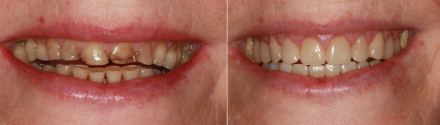
There is a more serious version of this problem. When wear is extensive and involves the posterior teeth as well, the available space may be insufficient to build anterior teeth of normal size and shape. These cases require restoration of the posterior teeth first, in order to increase the vertical dimension of the face, followed by aesthetic restoration of the anterior region.
4. The only concern is tooth colour
If you are satisfied with the shape and position of your teeth and your only wish is a lighter shade, you do not need veneers.
Teeth whitening is a conservative alternative that is completed within a short period and significantly improves the colour of the teeth.
5. Significant crowding
I have restored many cases of mild crowding with veneers. When teeth are significantly crowded, however, the indicated treatment is orthodontic.
Veneers can improve the perception of a tooth’s position, but not its actual position.
On a tooth positioned palatally, correction is achieved by increasing the thickness of the restoration. On a tooth projecting outside the dental arch, correction requires the removal of tooth structure. The greater the deviation, the greater the biological cost.
Aesthetic dentistry is an excellent option for patients who have considered orthodontic treatment and declined it for their own reasons.
The orthodontic assessment comes first, however, and the veneers follow.
6. The aesthetic problem in the smile is not caused by the teeth
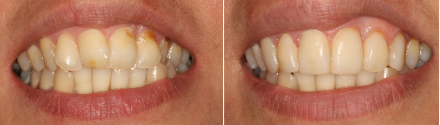
Some aesthetic concerns about a smile have nothing to do with the teeth. These include:
- a hypermobile upper lip
- excessive gingival display on smiling
- asymmetry of the jaw
- a facial midline that does not coincide with the dental midline
In these cases veneers do not correct the cause. The patient completes treatment and remains dissatisfied, without being able to identify why.
The error here is diagnostic: what actually troubles the patient was never established at the outset. Correct diagnosis is what secures a successful result with veneers.
7. The patient is not ready
A patient who does not know precisely what they want, or who arrives with a photograph of a smile convinced that it can be reproduced on their own face, is not ready for irreversible treatment.
Contemporary practice has tools that address this problem.
Digital smile design allows a simulation of the expected result to be created. In most cases that result can be trialled inside the mouth before any preparation of the teeth takes place.
When veneers are the right choice
Veneers are an excellent treatment option where there is a clear indication:
- discolouration that does not respond to whitening
- developmental defects of the enamel
- teeth with incomplete or disproportionate shape
- spacing that does not require orthodontic treatment, or that can only be addressed prosthetically
- black triangles or spaces that appeared after periodontal treatment
- worn incisal edges
Only when you are a suitable candidate can veneers genuinely benefit you.
How to choose a dentist for aesthetic restoration
A good result depends on two factors: the training and skill of the dentist, and the technical standard of the dental laboratory.
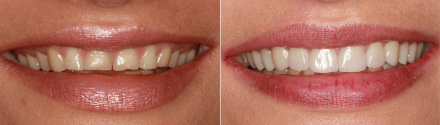
Ask to see photographic documentation of cases treated at that particular practice, preferably cases whose starting point resembles your own.
It is the most direct way to judge whether the aesthetic result achieved there matches what you are looking for.
If you are travelling to Athens for treatment
The clinical sequence described above cannot be compressed to fit a travel schedule. Periodontal treatment, caries control and orthodontic assessment take time, and digital planning with an intraoral trial of the proposed result should take place before any preparation of the teeth, not on the same day.
If you are considering treatment while visiting or living in Greece, allow for an initial assessment appointment that is separate from the treatment itself.
Frequently asked questions
Can I have veneers if I have gingivitis?
Not before the inflammation is treated. Inflamed gums bleed, which compromises bonding, and they recede after treatment, exposing the margin of the restoration.
If I grind my teeth, are veneers ruled out?
Not necessarily. Bruxism must be controlled, however, and a night guard worn after the restoration. Where wear is extensive, restoration of the posterior teeth may need to be included.
I only want whiter teeth. Do I need veneers?
If you are satisfied with the shape and position of your teeth, no. Whitening addresses colour without removing tooth structure.
Can veneers replace orthodontic treatment?
For mild deviations, yes. For significant crowding, no: prosthetic correction would require a disproportionate removal of tooth structure.
Can I see the result before I decide?
Yes. Digital smile design produces a simulation that in most cases is trialled inside the mouth before any preparation of the teeth, and helps you understand whether the result satisfies you.
Watch the video for more information (Greek audio, English subtitles available).
Dr Domna Evangelidou, DDS, MSc — Specialist Prosthodontist
DentArtistry, 80 Kifisias Avenue, Ambelokipi, Athens
Tel. +30 210 69 30 140
This article is for information only and does not replace individual clinical examination and diagnosis.
