

Hyperemesis gravidarum- Consequences in teeth and dental treatment
Vomiting during pregnancy is a common symptom, especially in the first trimester. It can cause dental problems because vomit contains stomach acids that can erode the teeth. Hyperemesis gravidarum can seriously damage teeth, because repeated, prolonged vomiting exposes them to stomach acid far more than ordinary morning sickness does.
In most pregnancies, vomiting is short-lived, so the damage to the teeth stays limited compared with the damage caused by bulimia, for example. But when vomiting is severe — the condition called hyperemesis gravidarum — it can cause dehydration and deprive the body of valuable nutrients, while at the same time posing a serious threat to the health of the teeth. The greater the amount and frequency of vomiting, the greater the risk of tooth erosion.
What is hyperemesis gravidarum?
Hyperemesis gravidarum is a severe form of nausea and vomiting in pregnancy. Unlike typical morning sickness, it involves frequent, prolonged vomiting that can lead to dehydration and nutritional deficiencies. Because the mouth is repeatedly exposed to stomach acid, the teeth are directly at risk.
How hyperemesis gravidarum affects teeth
Dental erosion starts with the enamel, the most superficial layer of the tooth, which is attacked by stomach acids and slowly dissolves. As teeth lose this protective layer, the underlying dentin — which is more susceptible to erosion and abrasion — is exposed to the oral environment, increasing the rate of loss of tooth structure.
The condition usually affects the palatal surfaces of the upper anterior teeth. In the early stages, the damage is difficult to detect, because the eroded surfaces are not easily visible to the patient. Gradually, the loss of dental substance extends to the cutting edge of the front teeth, which become thinner, wear down and create an unattractive smile.
In the advanced stages, there are usually changes in the posterior teeth, which develop morphological changes, sometimes leading to loss of the vertical dimension of the face.
Clinical case: severe erosion from hyperemesis gravidarum
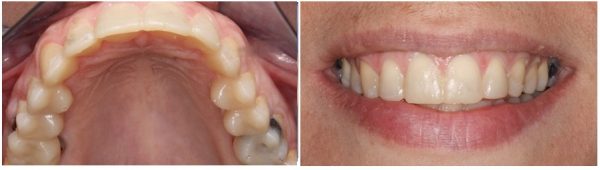
Here I present the case of a patient who suffered from hyperemesis gravidarum during two pregnancies. The patient’s teeth were severely eroded, especially on the palatal side of the anterior teeth and on the occlusal surface of the posterior teeth, as shown in the following photographs.

We can see the characteristics of dental erosion, such as the stronger colour of the teeth at the points where the enamel was lost, and the changes in the morphology of the teeth. In this case, the lesions were not significant in the lower teeth, which retained their morphology compared with the upper teeth.
The patient decided to seek dental treatment when the cutting edges of the front teeth broke, lost their shape, and the aesthetic problem became more pronounced.
Diagnosis and mock-up
The purpose of treatment in such a case is to repair the eroded teeth while preserving as much dental substance as possible. In the past, we used to prepare the teeth and place crowns, which caused additional loss of dental tissue. Today, with adhesive bonding, we can place small restorations that cover the exposed dentin and replace the lost tooth structure without further removal of tooth tissue.
To cover the exposed dentin and replace the structure lost through erosion, we need to slightly increase the vertical dimension of the face, creating the space needed to place the restorative materials on the teeth. We started the treatment with a diagnostic technique called a mock-up. Think of the mock-up as a test smile that lets us see the final result we want to achieve and gives us the opportunity to explain the treatment to the patient.
Restoring the posterior teeth (composite onlays)
The final restorations can be made of composite or porcelain, depending on the patient’s preference and finances. In this case, we used composite onlays to restore the posterior maxillary teeth. These are very conservative restorations, chemically bonded to the surface of the teeth after minimal preparation.
Bonding the onlays to the posterior teeth also increases the vertical dimension of the occlusion. This creates the necessary space to fabricate and bond restorations on the palatal side of the anterior teeth in the next step of the treatment.


Restoring the anterior teeth: the “sandwich” technique
At this stage of treatment, we have improved the anatomy of the teeth and covered the sensitive dentin. In our case, the loss of length was limited to the two central incisors, which is why these were the only teeth that required porcelain veneers.

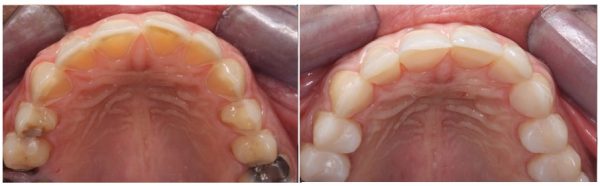
We then fabricated the veneers for the two central incisors, shown in the following photograph placed on the model and bonded in the mouth. For these most compromised teeth we made a kind of “sandwich”: a composite veneer on the palatal side and a porcelain veneer on the buccal side. The tooth structure left by the erosion was preserved intact between the two restorations, instead of being ground down for a crown.

Treatment results
The treatment was very successful. The posterior teeth and the occlusal surfaces of the anterior teeth were restored, the exposed dentin was covered, and the teeth became less sensitive to thermal stimuli. Porcelain veneers gave our patient a new, healthy and confident smile.
The only teeth with porcelain veneers are the two central ones. Soon we will restore the missing molar with a dental implant, and the occlusion will be finalized.


How to protect your teeth from pregnancy vomiting
To protect your teeth from the effects of pregnancy vomiting, follow these tips:
- Do not brush your teeth right after vomiting. Wait at least an hour before brushing, because acid temporarily softens the enamel.
- Rinse your mouth with water, or a solution of water and baking soda, after vomiting to help neutralize the acid.
- Use a fluoride toothpaste to strengthen your teeth.
- Avoid fizzy and carbonated drinks.
In some cases, such as the one described here, preventive measures are not enough and the effects on the teeth become visible. In these cases, modern dentistry can repair the damage and give patients the dental health they need to smile with confidence. Even in more complex situations, such as the bulimia tooth erosion case we analysed, proper dental care greatly improves the prognosis of eroded teeth. Don’t be discouraged — look for solutions and find the right treatment for you.
Frequently asked questions
Can vomiting during pregnancy damage your teeth?
Yes. Vomit contains stomach acid, which erodes enamel. In most pregnancies vomiting is short-lived and the damage stays limited. But in hyperemesis gravidarum — a severe form with frequent, prolonged vomiting — the risk of significant erosion is much higher. The greater the amount and frequency of vomiting, the greater the risk to the teeth.
Which teeth does hyperemesis gravidarum affect most?
It typically affects the palatal (inner) surfaces of the upper front teeth first, where early damage is hard to see. As it progresses, the cutting edges of the front teeth thin and break, and in advanced cases the back teeth lose their shape and the vertical dimension of the face can decrease.
Can eroded teeth be repaired without crowns?
Yes. In the past, teeth were prepared and crowned, which removed additional healthy tissue. Today, with adhesive bonding, small composite or porcelain restorations cover the exposed dentin and replace lost structure with minimal preparation, preserving as much natural tooth as possible.
What is the “sandwich” technique for eroded front teeth?
For the most worn front teeth, a composite veneer is bonded to the palatal (inner) side and a porcelain veneer to the buccal (outer) side. The natural tooth structure left by the erosion is preserved between the two restorations — like a sandwich — instead of being ground down for a crown.
How can I protect my teeth if I vomit during pregnancy?
Do not brush immediately after vomiting — wait at least an hour, because acid temporarily softens the enamel. Rinse with water, or a water and baking soda solution, to neutralize the acid. Use a fluoride toothpaste. Limit fizzy and acidic drinks. If erosion has already become visible, see a dentist for assessment.
This clinical case has been referenced in the international scientific literature: Coffey N, James L, Flynn AC, El-Dirani Z, Khijmatgar S. Hyperemesis gravidarum and oral health: A scoping review. Int J Gynecol Obstet. 2026. doi:10.1002/ijgo.70958
